

You sit down at your desk.
One hour passes. Then two. Then somehow it’s 4pm and your shoulders are up near your ears and your neck feels like concrete.
Sound familiar?
Here’s the thing: your body was not designed to sit still for eight hours a day.
But most of us do exactly that, five days a week.
The good news? You don’t need a standing desk, a personal trainer, or a gym membership to fix this.
You just need a few minutes, a little intention, and the right posture exercises at work to get your body feeling human again.
This guide will walk you through everything, step by step.
By the end, you’ll have a simple routine you can actually stick to, plus the science behind why this stuff really works.
Why Sitting Is Secretly Wrecking Your Body
Let’s talk about what’s actually happening when you sit hunched over a keyboard all day.
Your head weighs about 10 to 12 pounds when it’s sitting straight up.
But when you lean your head just 15 degrees forward (like most people do while looking at a screen), the effective load on your neck jumps to around 27 pounds, according to research published in Surgical Technology International.
That’s like carrying a small dog on your neck all day.
No wonder you’re exhausted.
Over time, that forward-head posture tightens your chest muscles, weakens your upper back, and can cause headaches, fatigue, and even breathing problems.
A study from the National Institutes of Health found that poor sitting posture is directly linked to musculoskeletal pain, reduced productivity, and lower energy levels at work.
And according to Mayo Clinic, taking regular breaks to stretch and move can dramatically reduce these effects.
The fix is not complicated.
It just needs to become a habit.
Set Up Your Desk the Right Way First
Before we get into the exercises, let’s make sure your workspace isn’t fighting against you.
Good desk posture exercises only go so far if your setup is all wrong.
Here’s a quick checklist:
- Feet: Flat on the floor, or on a footrest if needed
- Knees: Bent at roughly 90 degrees
- Screen: Top of the monitor at or just below eye level
- Keyboard: Elbows at 90 degrees, wrists relaxed (not bent up or down)
- Chair back: Supporting your lower back, not leaving a gap
- Distance from screen: About an arm’s length away
Even a small tweak here can reduce tension before it builds.
Now let’s get into the good stuff.
7 Posture Exercises at Your Desk (No Equipment Needed)
These posture exercises at your desk can be done right in your chair.
No gym. No mat. No changing clothes.
Just you, your chair, and five minutes.
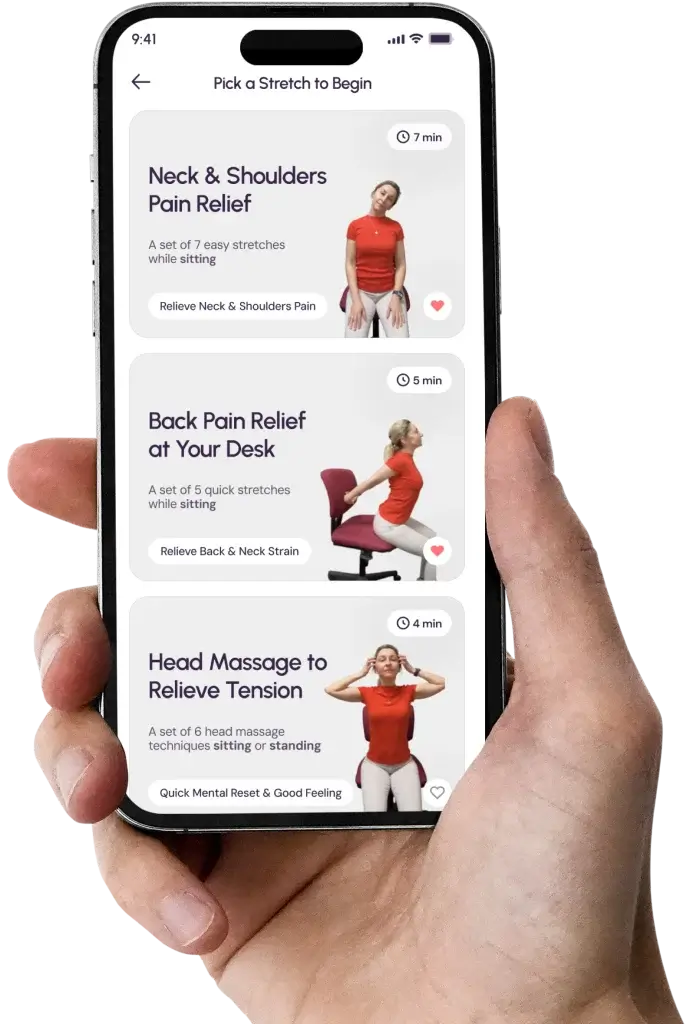
If you want guided versions of these stretches with audio cues, the Healthy Mind App’s office stretches walk you through each stretch.
1. Shoulder Rolls
This one is the quickest way to melt upper-body tension.
How to do it:
- Sit tall with your feet flat on the floor.
- Let your arms hang loose by your sides.
- Slowly roll both shoulders backward in big circles, 10 times.
- Then roll them forward, 10 times.
Focus on making the circles as big as possible.
You will probably feel a little cracking or popping. That’s normal.
Do this every single hour if you can.
2. Chest Opener Stretch
Hours of typing push your shoulders forward and tighten your chest.
This stretch is the antidote.
How to do it:
- Sit at the edge of your chair.
- Clasp your hands behind your lower back.
- Gently squeeze your shoulder blades together.
- Lift your chest upward and hold for 20 to 30 seconds.
- Breathe slowly and deeply while you hold.
- Repeat 2 to 3 times.
You should feel a stretch across the front of your chest and shoulders.
3. Neck Side Stretch
Your neck takes a beating when you stare at a screen all day.
This stretch gives it a little love.
How to do it:
- Sit tall and relax your shoulders.
- Gently tilt your right ear toward your right shoulder.
- Hold for 15 to 20 seconds.
- Switch to the left side.
- Then slowly turn your head left and right, like you’re saying “no” in slow motion.
- Repeat the whole sequence 2 times.
Do not force it. A gentle pull is all you need.
4. Seated Torso Twist
This one keeps your spine mobile and flexible.
How to do it:
- Sit tall with your feet flat on the floor.
- Place your right hand on the back of your chair.
- Put your left hand on your right knee.
- Gently twist your torso to the right.
- Hold for 10 to 15 seconds and breathe.
- Repeat on the left side.
Think of it like wringing out a wet towel, but gently.
5. Cat-Cow Stretch (Seated Version)
This is a classic yoga move adapted for your chair.
It wakes up your entire spine in about 60 seconds.
How to do it:
- Sit at the edge of your chair with hands resting on your knees.
- Inhale and arch your back, lifting your chest and letting your belly drop forward. (This is Cow.)
- Exhale and round your spine, tucking your chin toward your chest. (This is Cat.)
- Move slowly and smoothly between the two.
- Repeat 8 to 10 times.
This is one of the best desk posture exercises for your lower back specifically.
6. Wrist and Forearm Stretch
Typing all day creates a surprising amount of tension in your wrists and forearms.
This stretch helps prevent soreness before it starts.
How to do it:
- Extend your right arm straight out in front of you, palm facing up.
- Use your left hand to gently pull your fingers back toward you.
- Hold for 15 to 20 seconds.
- Switch hands.
- Then flip the palms down and repeat.
Simple, quick, and very effective.
7. Seated Figure-Four Hip Stretch
Sitting all day tightens your hips more than most people realize.
Tight hips pull on your lower back and throw your whole posture off.
How to do it:
- Sit tall in your chair.
- Cross your right ankle over your left knee.
- Sit up straight and gently lean forward at the hips (not the waist).
- Hold for 20 to 30 seconds.
- Switch sides.
You should feel a stretch deep in your right hip.
The Breathing Connection (This Part Is Often Missed)
Here is something most people don’t realize about posture.
When you slouch, your ribcage compresses your lungs.
That means you’re taking shallower breaths all day without even knowing it.
Shallow breathing = less oxygen = more fatigue, more brain fog, more stress.
A study from NIH found that diaphragmatic breathing (deep belly breathing) reduces cortisol levels and improves mental focus.
That’s why pairing your desk stretches for posture with intentional breathing makes such a big difference.
Try this simple breathing reset:
- Sit tall and plant your feet on the floor.
- Breathe in slowly through your nose for 4 counts, letting your belly expand.
- Hold for 2 counts.
- Breathe out through your mouth for 6 counts.
- Repeat 5 to 8 times.
The Healthy Mind App’s breathwork feature guides you through breathing exercises exactly like this one.
It uses audio cues that tell you when to inhale, hold, and exhale so you don’t have to count yourself.
You just close your eyes and follow along.
How to Actually Build This Into Your Day
Reading about stretches is the easy part.
Actually doing them when you’re deep in a project, back-to-back in meetings, and answering 47 Slack messages is harder.
Here’s a simple schedule that works even on your busiest days:
Morning (when you first sit down, 3 to 5 minutes):
- Shoulder rolls
- Chest opener
- Deep breathing reset
Mid-morning (before your second meeting, 2 to 3 minutes):
- Neck side stretch
- Seated torso twist
After lunch (2 to 3 minutes):
- Seated cat-cow
- Wrist and forearm stretch
Late afternoon (when the energy dip hits, 3 to 5 minutes):
- Figure-four hip stretch
- Full breathing reset
That’s it.
The whole thing takes about 10 to 15 minutes spread across your whole workday.
The Healthy Mind App’s habits calendar lets you set reminders for each of these blocks.
It pings you at the times you choose, so you never forget to take a break.
Over time, this kind of consistent movement becomes second nature.
What About the Afternoon Energy Crash?
You know the one.
It hits around 2 or 3pm and makes everything feel twice as hard.
Slumped posture is a sneaky contributor to that crash.
When your body is tense and compressed, you’re spending energy just holding yourself up.
Doing your posture stretches at desk in the early afternoon, paired with music that helps your brain focus, can genuinely shift how the rest of your day feels.
The Healthy Mind App’s brain music plays specially curated audio designed to improve concentration and reduce mental fatigue.
A lot of people pair it with their afternoon stretch break and notice a real difference in their focus afterward.
Quick Wins: Posture Habits You Can Start Right Now
Not every fix requires a full routine.
Here are some tiny tweaks with a big payoff:
- Every time you pick up your phone, bring it to eye level instead of looking down at it.
- Every time you start a new task, take three deep breaths first.
- Every time you get up to refill your water, do 5 shoulder rolls on the way back.
- Every time you sit back down, do a quick posture check: feet flat, back supported, screen at eye level.
- Every hour on the hour, stand up for just 30 seconds.
Small things, done consistently, add up to big changes.
Your Posture is a Habit, Not a Destination
Here’s the mindset shift that makes everything easier.
Good posture is not a position you hold. It’s a habit you build.
Your body needs movement throughout the day, not just a “correct” seated position.
The people with the best posture are not the ones sitting stiff and rigid.
They’re the ones moving a little, adjusting often, and checking in with their bodies regularly.
That’s what these posture exercises at work are really about.
Not fixing you.
Just reminding your body of what it already knows how to do.
If tension and stress build up alongside your posture issues (and they usually do), the Healthy Mind App’s tension relief tools offer guided exercises specifically for releasing physical and mental tension.
It’s a nice place to go when you feel the weight of the day starting to settle into your shoulders.
The 5-Minute Routine (When You Have Almost No Time)
Some days are just wild.
When you’re truly slammed, do this one routine.
It hits the most important areas in five minutes flat:
- Shoulder rolls (forward and back, 10 each): 1 minute
- Chest opener stretch (hold 30 seconds, repeat twice): 1.5 minutes
- Neck side stretch (each side, 20 seconds): 1 minute
- Breathing reset (5 slow deep breaths): 1 minute
- Seated cat-cow (8 reps): 30 seconds
Done.
Even that tiny investment makes a difference you can feel.
Wrapping It Up
Stiff shoulders, sore necks, and afternoon brain fog don’t have to be part of your workday.
Posture exercises at work are one of the highest-leverage things you can do for your comfort, energy, and focus.
Whether you use a full daily schedule or just sneak in the five-minute routine, your body will thank you.
And if you want a little support staying consistent, the Healthy Mind App has guided stretches, breathing exercises, brain music, and habit reminders all in one place.
Think of it as a supportive friend who nudges you to take a break before your neck starts yelling at you.
Start today, even if it’s just one stretch.
Your future self will notice the difference.