

Take a second. Look at that image below.

Breathe in slowly through your nose. Let it out.
If you clicked on this article, chances are your chest is a little tight right now.
Maybe your thoughts are racing.
Maybe you’ve been dreading something at work all day, all week, or for months.
That tiny moment you just took?
That’s the kind of simple, quick reset this whole guide is about.
Whether you’re dealing with anxiety in the workplace for the first time or you’ve been managing it for years, there are real things you can do to feel more in control, more confident, and even enjoy your workday again.
If you’ve been searching “anxiety at work what to do,” you’re in the right place.
This guide is all about managing anxiety at work with simple tools that actually fit into your day.
Let’s walk through it together.
First Off: You’re Not Alone (and You’re Not “Broken”)
Here’s something that might surprise you: anxiety in the workplace is incredibly common.
Millions of people deal with it every day.
Smart, talented, hardworking people. People who look totally fine on the outside but are quietly battling racing thoughts, tight chests, and “what if” spirals on the inside.
If that sounds familiar, it just means your brain is working overtime to protect you.
It’s not a flaw. It’s your nervous system doing its job a little too well.
The great news?
There are simple ways to turn down the volume on that alarm system.
And they don’t require hours of your time or a complete life overhaul.
Whether you’re dealing with stress and anxiety at work or just trying to reduce work anxiety before it gets worse, a few small habits can make a huge difference.
Stress vs. Anxiety: A Quick (and Helpful) Difference
These two get mixed up all the time, so let’s untangle them.
Stress is usually tied to something specific:
- A deadline
- A big presentation
- A heavy workload
When the thing is done, the stress fades. It has an off switch.
Anxiety is trickier. It can show up even when nothing is obviously wrong:
- A general sense that something bad is about to happen
- Overthinking conversations that already happened
- Dreading work before the day even starts
Understanding which one you’re dealing with helps you pick the right tools.
And the good news is that the tools in this guide work for both.
What Anxiety at Work Can Look and Feel Like
Anxiety doesn’t always look like what you’d expect. It’s not always dramatic or obvious.
Sometimes it’s subtle and sneaky.
Your body might be telling you:
- Tight shoulders or a clenched jaw
- Butterflies in your stomach (the not-fun kind)
- Feeling tired even after a full night’s sleep
- Headaches that pop up during the workday
Your mind might be doing this:
- Running through worst-case scenarios on repeat
- Second-guessing every decision or email you send
- Feeling like you’re “faking it” and people will figure it out
- Having trouble focusing because your thoughts are so loud
You might catch yourself:
- Avoiding tasks that feel overwhelming (not out of laziness, out of anxiety)
- Over-preparing for things to feel more in control
- Saying yes to everything because saying no feels scary
- Skipping lunch with coworkers because socializing feels like a lot
If some of these resonate, that’s actually great.
Recognizing it is the first step toward feeling better. And you just took it.
Why Work Can Be an Anxiety Trigger (It’s Not Your Fault)
Let’s be clear: if work is causing anxiety, it doesn’t mean you’re in the wrong career or that you’re not cut out for it.
Lots of people experience work causing anxiety at some point, and it usually has more to do with the environment than with you.
There are real, structural reasons why work can trigger anxiety:
- You can’t always walk away – Unlike other stressors, work is there every day. You can’t just avoid it.
- Expectations can be unclear – When you don’t know what “good enough” looks like, your brain fills the gap with worst-case assumptions.
- People dynamics are complicated – Whether it’s anxiety caused by work colleague interactions, a tough boss, or office politics, other humans can be a huge source of workplace anxiety.
- There’s no built-in recovery time – Most jobs don’t give you a chance to mentally reset between tasks. So the tension just keeps stacking up.
Once you understand why your anxiety is showing up, it gets a lot less confusing and a lot more manageable.
Breathwork for Anxiety: The Simplest, Fastest Tool You Have
If you only try one thing from this guide, make it this.
Your breath is like a remote control for your nervous system.
When you’re anxious, your breathing gets shallow and fast.
This signals your brain: “Danger! Stay alert!” Which makes you more anxious. It’s a loop.
Breathwork for anxiety breaks that loop.
Slow, deep breaths flip the switch from “fight or flight” to “safe and calm.”
And science confirms it works.
A scientific study of 785 adults found that breathwork significantly reduced both stress and anxiety.
Another NIH study found that just 5 minutes of daily breathing exercises improved mood more effectively than mindfulness meditation alone.
Two easy techniques to try:
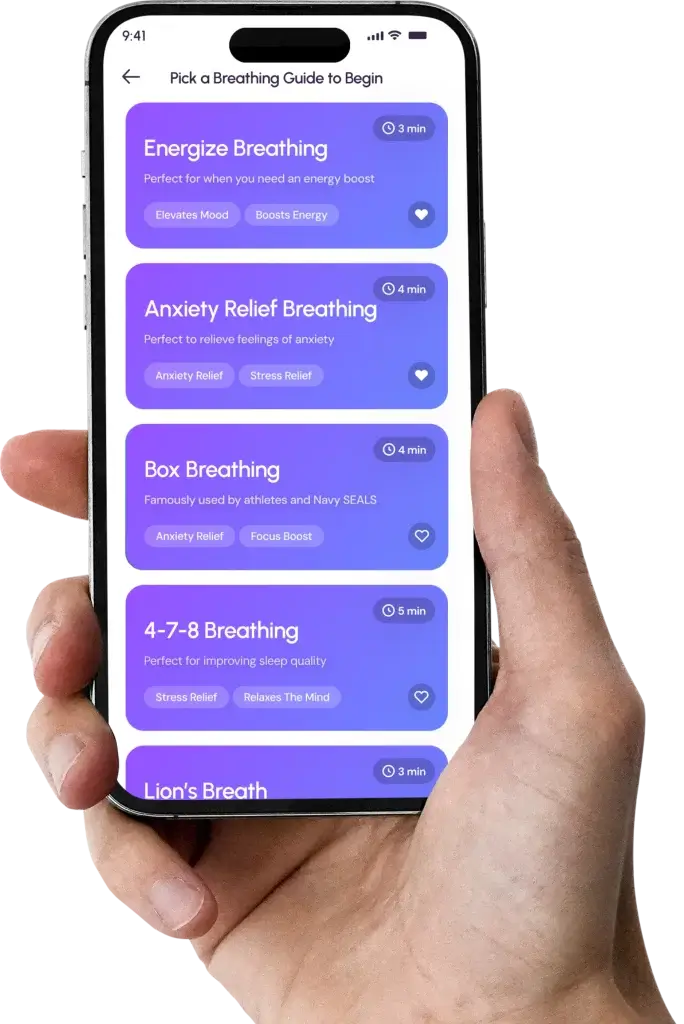
Cyclic Sighing (great for lifting your mood):
- Breathe in deeply through your nose
- At the top, take one more short sip of air to fully fill your lungs
- Slowly exhale everything out through your mouth
- Repeat for 2 to 5 minutes
Box Breathing (great for calming down quickly):
- Breathe in for 4 counts
- Hold for 4 counts
- Breathe out for 4 counts
- Hold for 4 counts
- Repeat 3 to 5 times
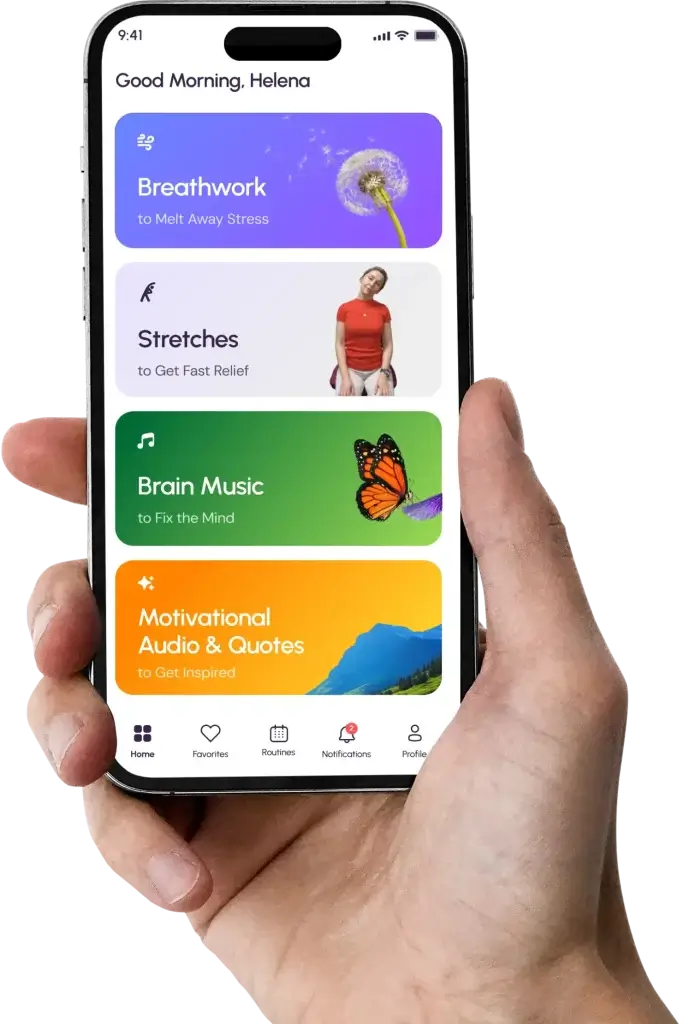
The Healthy Mind App’s breathwork feature guides you through techniques like these with step-by-step audio and calming nature visuals. No need to count or time yourself. Just press play and follow along.
Dealing With Social Anxiety at Work
For a lot of people, the hardest part of work isn’t the tasks. It’s the people.
Dealing with social anxiety at work might look like:
- Getting nervous before meetings where you might need to speak up
- Overanalyzing what you said in a conversation hours later
- Feeling your heart race when someone puts you on the spot
- Avoiding team lunches or social events
Here’s the thing: you don’t have to become an extrovert to manage this. You just need a few small strategies that build your confidence over time.
Before a meeting or interaction:
- Write down 1 to 2 things you could say (having a plan reduces the “blank mind” panic)
- Do a 60-second breathing exercise to steady your nerves. The Healthy Mind App has sessions short enough to fit right before a call starts.
During the interaction:
- Focus on listening instead of performing. Ask a question instead of making a statement. It takes the pressure off.
- Remember: most people are thinking about themselves, not judging you.
After:
- Do a quick desk stretch to release the tension your body stored during the interaction
- Let it go. You did great. Even if it didn’t feel like it.
Small wins add up. Every time you speak up, send that message, or show up to that lunch, your brain learns: “That was okay. I survived. Maybe next time won’t be so scary.”
When Anxiety Feels Like Too Much to Work Through
Some days, anxiety gets loud. You can’t focus.
You read the same email three times. You feel frozen.
If you’ve ever felt like you have too much anxiety to work, or like you’re experiencing crippling anxiety at work that makes even basic tasks feel impossible, know that this happens to more people than you’d think.
That’s okay. It happens. And there’s a way through it.
Step 1: Give Yourself a 5-Minute Reset
Don’t force yourself to power through. It won’t work and you’ll just feel worse. Instead, step away from your screen for 5 minutes.
Step 2: Get Into Your Body
Anxiety lives in your thoughts. The fastest exit is through your body:
- Feel your feet flat on the floor
- Notice the temperature of the air
- Take 5 slow breaths, paying attention to how your chest rises and falls
This is called grounding, and it gently pulls your brain out of the thought spiral.
Step 3: Start Ridiculously Small
Don’t try to tackle everything. Ask yourself: “What is the tiniest possible next step?”
- Open the document
- Write one sentence
- Reply to one email
That’s enough. Momentum builds from there.
Step 4: Change the Inputs
Put on some brain music to shift your mental state.
Or listen to a quick motivational clip to remind yourself that you’ve handled hard things before.
Sometimes your brain just needs a different signal to break the loop.
Beating the “Anxiety About Going to Work” Feeling
You know that Sunday night dread? When the weekend is ending and your chest starts to tighten just thinking about Monday?
Or the alarm goes off and your first thought is, “I can’t do this”?
That anxiety about going to work is your brain running “what if” simulations before anything has actually happened.
Here’s an evening routine that helps quiet it:
- Write down your top 3 tasks for tomorrow (gets the swirling thoughts out of your head and onto paper)
- Do a short breathing exercise to tell your brain, “Right now, in this moment, I’m safe”
- Listen to calming brain music or look at nature imagery as you wind down
The Healthy Mind App’s habits calendar can remind you to do this every evening so it becomes automatic, like brushing your teeth for your brain.
Your Daily Anxiety-Busting Routine (Simple and Flexible)
Overcoming work anxiety doesn’t happen in one big moment.
It happens through small, daily habits that gradually lower your baseline anxiety.
Here’s a sample routine you can mix and match:
Before work:
- 2-minute breathing exercise to start calm
- Write your top 3 priorities for the day
During work:
- Brain music during focus blocks to keep anxious thoughts quiet
- A quick desk stretch after tough meetings or calls
- 60-second breathing reset before any anxiety-triggering interaction
After work:
- A short motivational listen to close the day with a win
- An evening wind-down with breathing and nature imagery
Set it up once in the Healthy Mind App’s habits calendar and let the reminders do the work for you.
When to Reach Out for More Support
Everything in this guide is designed to help you manage anxiety at work day to day.
But sometimes you need (and deserve) more support.
It might be time to talk to a professional if:
- Self-help strategies aren’t making a noticeable difference
- Anxiety is affecting your sleep, relationships, or health
- You’re having panic attacks regularly
- You’re relying on substances to get through the day
Here’s the encouraging part: anxiety is one of the most treatable conditions out there.
A good therapist can give you personalized tools that go way deeper than any article can. Reaching out is brave, not weak.
You’ve Already Started
You read this far. That means you’re taking your wellbeing seriously, even when anxiety is telling you nothing will help.
That’s a big deal. Give yourself credit for it.
Dealing with anxiety in the workplace isn’t about becoming fearless.
It’s about building a toolkit of small habits that help you feel calmer, more confident, and more like yourself at work.
Start with one thing today. Just one.
A breathing exercise. A desk stretch.
A nature image that gives you 10 seconds of peace.
The Healthy Mind App puts all of these tools in one place.
Guided breathwork, calming nature imagery, desk stretches, focus music, and motivational audio, all designed for people managing stress and anxiety at work.
You don’t have to figure this out alone. And you definitely don’t have to keep white-knuckling through every workday.
There’s a calmer way. And it starts with your next breath.