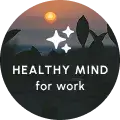

Before you read a single word, just look at that image for a moment.

Take one slow breath in. Let it out.
Feel that little shift?
That’s real.
Research published by the National Institutes of Health found that simply viewing nature scenes helps your nervous system recover from stress faster.
Even a few seconds of looking at natural landscapes can start to quiet the stress response in your brain.
That’s why the Healthy Mind App features calming nature imagery throughout every experience, from breathing exercises to stretching to brain music.
It’s designed to feel like a mental escape, even when you’re sitting at your desk.
Now imagine being able to tap into that feeling anytime during your workday.
That’s what this guide is all about.
Here’s something nobody tells you about work stress: it doesn’t start when things go wrong.
It starts quietly.
A tightness in your shoulders you barely notice.
A shorter temper with people you actually like.
Waking up on Monday already dreading Friday.
By the time you Google “how to manage stress at work,” your body has been waving red flags for weeks.
This guide is different from the usual “just take a deep breath” advice.
We’re going to dig into why work stress gets so bad, how to spot it before it spirals, and give you real stress management techniques in the workplace that fit into a packed schedule.
The Real Reason Work Stress Feels So Hard to Shake
Most stress advice treats the symptoms.
It tells you to relax, but doesn’t explain why relaxing feels impossible.
Here’s what’s actually happening in your body.
When you’re under pressure, your brain activates something called the “fight or flight” response.
Your body floods with cortisol and adrenaline.
Your heart beats faster. Your muscles tense. Your brain shifts into survival mode.
This is great if you’re running from danger.
Not so great when you’re sitting in your third Zoom call of the morning.
The problem? Your body can’t tell the difference between a tiger and a tight deadline. So it stays in stress mode all day, every day.
A study published by the National Institutes of Health found that this kind of chronic workplace stress is directly linked to lower productivity, worse job satisfaction, and increased health problems.
That’s why learning how to deal with stress at work isn’t just about “feeling better.”
It’s about breaking the cycle before it breaks you.
Are You More Stressed Than You Think? (Check These Signs)
Stress is sneaky. It disguises itself as normal life.
Here are some signs that your work stress has crossed the line from “busy” to “too much”:
Physical signs:
- Headaches that show up like clockwork during the workday
- Jaw clenching or teeth grinding (especially at night)
- Neck and shoulder pain that never fully goes away
- Trouble falling asleep or waking up still tired
- Getting sick more often than usual
Mental and emotional signs:
- Feeling overwhelmed before the day even starts
- Dreading tasks you used to handle fine
- Snapping at coworkers or family over small things
- Zoning out in meetings or forgetting what you just read
- A constant sense of “I can’t keep up”
If three or more of these sound familiar, your stress isn’t just a bad week.
It’s a pattern, and it needs attention.
How To Deal With Stressful Situations at Work (Without Losing It)
Let’s start with those high-pressure moments. The ones where stress hits you like a wave.
Maybe your boss drops an impossible deadline on you. Maybe a coworker throws you under the bus in a meeting.
Maybe you open your inbox and find 47 unread emails before 9 AM.
Here’s how to manage stressful situations at work in the moment:
Stop. Don’t React Yet.
Your stressed brain wants to fire off an angry reply or panic about the deadline.
Don’t let it.
Give yourself 60 to 90 seconds before you respond to anything.
This sounds tiny, but it’s powerful.
That pause gives your brain time to shift out of “fight or flight” and into clear thinking.
What to do during that pause: Take 3 to 5 slow, deep breaths. Breathe in through your nose for 4 counts, out through your mouth for 6 counts.
This activates your parasympathetic nervous system, which is your body’s built-in calm-down switch.
Research in Frontiers in Psychology (NIH) confirmed that this kind of controlled breathing reduces cortisol and improves focus in just a few minutes.
If you want guided support for this, the Healthy Mind App’s breathwork walks you through calming breathing exercises designed for exactly these moments.
Shrink the Problem
Stress makes everything feel massive. Your brain exaggerates the threat because it’s in survival mode.
Fight back by making the problem smaller:
- Ask: “What is the ONE next thing I need to do?” (Not the whole project. Just one step.)
- Write it down. Getting the task out of your head and onto paper reduces mental overload instantly.
- Set a timer. Tell yourself: “I’ll work on this for 15 minutes.” Short bursts feel way less scary than “I need to finish this.”
Change Your Physical State
Your mind and body are connected. If your body is tense, your brain stays in stress mode.
Interrupt the cycle by moving:
- Stand up and shake out your hands
- Do 10 shoulder rolls
- Walk to get water (the movement matters more than the water)
- Do a quick 2-minute stretch at your desk
The Healthy Mind App’s stretching has desk-friendly routines built for exactly this. They’re quick, quiet, and you won’t attract weird looks from coworkers.
Give Your Eyes a Nature Break
Here’s one you probably haven’t tried: just looking at nature can lower your stress.
It sounds almost too easy.
But research published in Environmental Science & Technology (NIH) found that viewing nature scenes activated the parasympathetic nervous system and helped the body recover from stress faster than viewing urban or indoor environments.
Even images of nature, not just the real thing, can make a difference.
Your brain has a built-in connection to natural landscapes.
When you see trees, water, open skies, or greenery, your nervous system reads it as “safe” and starts to relax.
What you can do:
- Step outside for 2 minutes and look at trees, sky, or grass
- If you can’t go outside, look at a nature photo or screensaver
- Keep a plant on your desk (even a small one helps)
This is one of the reasons the Healthy Mind App features calming nature imagery throughout the entire experience.
Whether you’re doing a breathing exercise, stretching, or listening to brain music, you’re surrounded by natural landscapes and soothing visuals.
It’s not just decoration. It’s designed to help your brain shift into a calmer state while you practice.
Ways To Relieve Stress at Work Throughout Your Whole Day
Dealing with stress in the moment is important.
But the best ways to deal with stress at work are the ones that prevent it from building up in the first place.
Here are ways to relieve stress at work that you can weave into your normal routine:
Morning: Set Your Baseline
How you start your day matters more than you think.
If you dive straight into emails and meetings, you’re handing control of your mental state to everyone else. Instead, take 2 to 5 minutes to set your own tone.
Options:
- A quick breathing exercise to center yourself before your first task
- Listening to calming or focus-enhancing music while you plan your day
- Writing down your top 3 priorities (not 15, just 3)
The Healthy Mind App’s brain music feature has focus tracks you can play while you set up your workday.
It helps your brain ease into “work mode” instead of slamming into it.
Midday: Break the Stress Buildup
By noon, stress has been quietly stacking up for hours. Most people push through. That’s a mistake.
A 5-minute reset in the middle of your day can prevent the afternoon crash.
Try one of these:
- A guided breathing session (even 2 minutes works)
- A desk stretch routine to release the tension in your neck and shoulders
- A walk around the block with no phone in your hand
- Listening to a short motivational clip to reframe your afternoon
The Healthy Mind App’s motivational audio is great for this.
It gives you a quick mental lift without eating up your lunch break.
Afternoon: Protect Your Focus
This is when stress and fatigue team up against you.
Your focus drops. Your patience thins. Everything feels harder.
The best stress management techniques in the workplace for the afternoon are about protecting your remaining energy:
- Single-task. Stop trying to do three things at once. Pick one thing and finish it.
- Use background music. Instrumental or ambient tracks keep your brain engaged without adding noise. The Healthy Mind App’s brain music is designed for this.
- Take micro-breaks. A 60-second pause every 45 to 60 minutes keeps your brain from overheating.
End of Day: Close the Loop
One of the biggest reasons work stress follows you home is that your brain never gets a clear “done” signal.
Before you log off, try this:
- Write down what you finished today (this gives your brain closure)
- Note your top priority for tomorrow (so you’re not anxious about forgetting)
- Do a short breathing exercise or listen to calming music to signal the transition from “work mode” to “home mode”
The Healthy Mind App’s habits calendar can remind you to do this end-of-day wind-down so it becomes automatic.
The 6 Biggest Mistakes People Make When Trying to Manage Stress
Knowing how to manage stress at work also means knowing what NOT to do.
Here are the traps most people fall into:
- Waiting until you’re burned out to do something – Stress relief works best as prevention, not emergency care. Start small habits now.
- Using your phone as a “break” – Scrolling social media isn’t rest. It’s more stimulation.
Your brain needs actual quiet. - Thinking you need a lot of time – You don’t need 30 minutes. Two minutes of breathing or stretching can reset your stress levels. That’s what tools like the Healthy Mind App are built for.
- Ignoring physical tension – If your shoulders are up by your ears, your brain thinks you’re still under threat. Release the tension and your mind follows.
- Trying to “think your way” out of stress – Stress lives in your body, not just your head.
Physical tools (breathing, movement, music) work faster than willpower. - Not asking for help – Talk to your manager, a trusted coworker, or a professional.
You don’t get bonus points for suffering alone.
What Makes Work Stress Different From Regular Stress
You might be thinking, “Stress is stress. Why does work stress need its own guide?”
Good question.
Here’s why:
- You can’t easily walk away – Unlike other stressors, you show up to work every day. You can’t just avoid it.
- It’s repetitive – The same triggers hit you day after day, which makes the stress accumulate instead of resolving.
- There’s a power dynamic – You often can’t control the source of your stress (your boss, your workload, company decisions).
- It bleeds into everything – Work stress doesn’t stay at work. It affects your sleep, your relationships, your health, and your happiness.
That’s exactly why learning specific ways to relieve stress at work is so important.
Generic advice like “just relax” doesn’t cut it when the stressor is sitting in your inbox every morning.
You need fast, practical tools that work inside the constraints of a workday.
Your Stress-Relief Toolkit: A Quick Recap
Here’s your cheat sheet for how to deal with stress at work, all in one place:
In the moment (when stress hits hard):
- Pause for 60 seconds before reacting
- Take 3 to 5 slow, deep breaths
- Shrink the problem to just the next step
- Move your body to break the tension
Throughout the day (to prevent stress buildup):
- Morning: Set your baseline with breathing or focus music
- Midday: Take a 5-minute reset (stretch, breathe, or walk)
- Afternoon: Single-task and use background music for focus
- End of day: Close the loop with a wind-down routine
Tools that make it easy:
- Guided breathwork for fast stress relief
- Desk stretches to release physical tension
- Brain music to protect focus and calm your mind
- Motivational audio for a quick mental lift
- Habits calendar with reminders to make it all stick
The Healthy Mind App puts all of these in one place. It’s free, it takes seconds, and it works on your phone or laptop.
One Last Thing
Stress at work will never fully disappear. But it doesn’t have to run your life.
The people who handle work stress best aren’t tougher or calmer by nature.
They just have better tools and use them consistently.
Start with one thing from this guide. Just one. Do it tomorrow.
That’s how to manage stress at work for real. Not by changing everything at once, but by building one small habit at a time.